
What to do (and what not to do) when someone is choking
A simple everyday action like swallowing can become a life-threatening emergency. For this reason, it is important to recognise the signs of choking and know how to act in this risky situation.
Every year, the Spanish emergency services attend thousands of cases of choking, a problem that caused 3,546 deaths in Spain in 2022, according to the Observatory for Prevention of Risks and Accidents (OPRA), being the third cause of unnatural death in the country.
Although most cases may be resolved without any complications, when the respiratory tract becomes completely obstructed, the fast action of whoever is close by can save a life.
How to recognise when someone is choking
Choking occurs when a piece of food or another object partially or totally blocks the passage of air to the lungs. The key is to distinguish between the two situations. If the person can cough, talk or breath, although with difficulty, it is a partial obstruction. In these cases, the safest idea is to encourage the person to cough strongly and monitor their evolution. You should not put your fingers in their mouth or hit their backs unnecessarily, as it could make the obstruction worse.
On the other hand, if the person cannot make any sounds, has an ineffective cough, clutches their neck or starts to show signs of suffocation, we are talking about a complete obstruction, a real emergency that requires immediate action while calling 112. If at any time, the person loses consciousness, start cardio pulmonary resuscitation (CPR) while waiting for the healthcare team to arrive. And, although the obstruction comes out, it is advisable for the person to be looked at by a professional, particularly if the Heimlich manoeuvre has been applied.
Babies and pregnant women: what changes?
- Babies (under a year old). The Heimlich manoeuvre should not be performed. The baby should be placed face down over the forearm, with the head lower than the trunk, hitting the back in between the shoulders gently, but firmly five times. If this does not work, the child should be turned face up and five chest compressions should be applied using two fingers, in the centre of the chest. This cycle may be repeated while someone calls 112.
Pregnant women (last trimester) or people with abdominal obesity. Abdominal pressure may be ineffective or unsafe. Instead of this, chest compressions are carried out with the arms around the trunk underneath the armpits and pressing inwards at the centre of the breastbone.
What to monitor after the “fright”
Although the obstruction has been resolved, a medical valuation is advisable, particularly if the Heimlich manoeuvre has been applied.
After choking, abdominal or chest discomfort may appear, along with a hoarse voice, irritation in the throat or small muscular pains. If hours later, a persistent chest pain appears, with difficulty in breathing, coughing blood up or a feeling of a foreign body inside them, the person should go to A&E.
How to act in the event of choking?

Hitting the back (5 times)
1 of 2
Place yourself behind the person, slightly to one side. Hold them around the chest in order to bend their trunk forward (in this way, if the object comes out, it will not go back in again). With the base of the free hand, hit the back up to five times sharply between the shoulder blades.
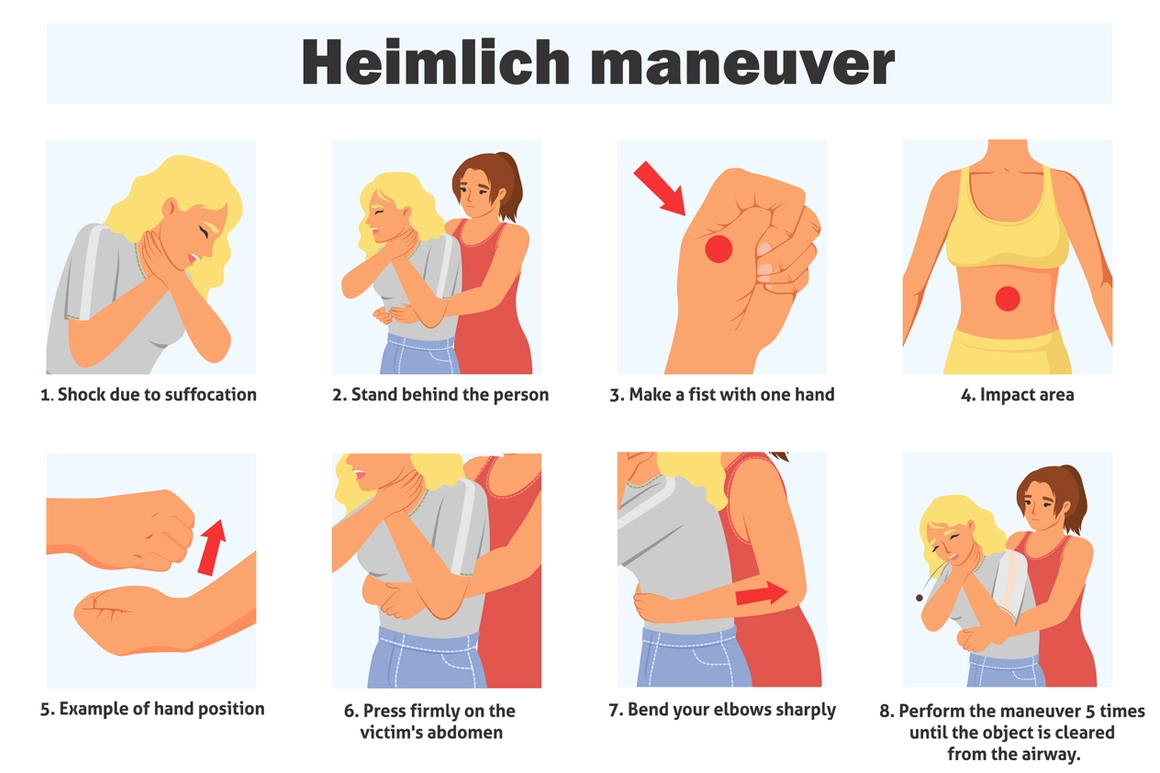
Heimlich manoeuvre (up to 5 compressions)
2 of 2
Heimlich Manoeuvre. Developed by the American doctor Henry Judah Heimlich in 1974, it is a first aid technique to clear the respiratory tract when an object has blocked the air passage.
Place yourself behind the person, put both arms around their waist and close one hand forming a fist just above the navel. Hold onto this fist with the other hand and perform fast compressions inwards and upwards, as if you wanted to shape a J. Alternate five compressions and hitting the back five times until the object comes out or the person recovers their breathing.