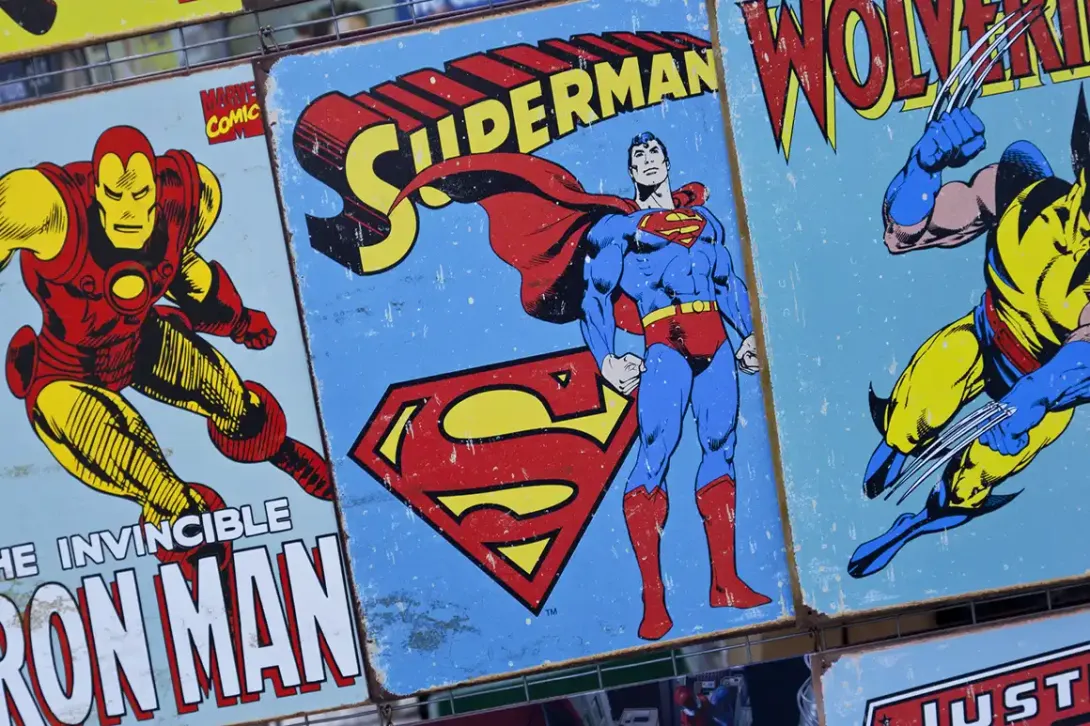
How did comics become a collector’s item?
Initially intended as a product for casual consumers and targeted at a very specific segment of the population, comics have become a treasured collectors’ item.
Few cultural objects have travelled such a unique path as the comic book. Born as an ephemeral, very affordable, product designed to be read and discarded, today it is one of the most coveted assets by collectors around the world.
Remembering its history also enables us to understand how popular culture can grow in value as an asset to the point of becoming artistic heritage, an opportunity for investment and a key item in libraries and archives. Full of material and social changes, the history of the comic book tells the story of how this product has gone from the hands of children to the showcases of museums and auction houses, with millions being paid for some copies.
The great importance in pop culture of many characters that were born in comic books and that nowadays generate millions, largely due to their film adaptations, action figures or other merchandising, leads us to consider comics beyond the printed page, realizing that they are a medium which triggers our imaginations.
From disposable entertainment to collector's item
During the 1930s and 1940s, comics were hastily printed, on cheap newsprint and with inks designed to be short-lived. The goal was clear: to sell millions of copies to an audience seeking affordable entertainment, in the midst of the Great Depression and during the Second World War. No one imagined that those stapled-together booklets, full of printing errors, misaligned pages and washed-out colours, would, in due time, become priceless relics.
And that very fragility would be precisely what would drive their current value. Of the millions of copies printed in their heyday, less than 1% have been preserved. Those that have managed to survive have done so in a very broad range of conditions, boosting their rarity and value. Add to this their historical importance (such as the legendary Action Comics No. 1, with the first appearance of Superman), and the comic book ceases to be mere entertainment, becoming a cultural and financial asset.
From the 1970s onwards, the comic book market underwent a radical transformation, with the emergence of a specialised sector that fully established its transformation from an ephemeral product into a collector's item. It is in this period that the first stores dedicated exclusively to comics appeared, making access to old and rare editions much easier, as well as enabling the creation of communities of fans and collectors.
At the same time, comic book conventions began to be organized, such as the San Diego Comic-Con, founded in 1970, which today is one of the largest global events dedicated to comic book culture and entertainment. But, without a doubt, a fundamental milestone was the publication of the Overstreet Comic Book Price Guide, in 1970, by Robert M. Overstreet. This guide established standardized criteria for the valuation of comics, providing collectors and sellers with objective benchmarks to assess the condition and price of each copy. This led to the professionalization of this market and the role of the collector was legitimized, operating, from now on, in a more transparent and well-regulated market.
Comics in contemporary collecting
In the following decades, this professionalization was further enhanced with the appearance of certifying companies, such as the Certified Guaranty Company (CGC), founded in the year 2000. These companies brought in a numerical grading system, similar to the one used in numismatics, to assess the condition of comics. An item that has been evaluated and sealed by CGC is locked into a rigid plastic case, with a label that certifies its authenticity and its condition, which generally ranges between 0.5 and 10.0. With this process, not only is the comic book physically protected, but also its function is transformed: the comic is no longer seen as an object to be read, but rather becomes an exhibition and conservation piece, and an investment, whose value can grow significantly on the secondary market.
The combination of all these factors has raised comics to the category of cultural and financial assets, comparable in many ways to other forms of collectible art. Historically significant items such as Action Comics No. 1 or Detective Comics No. 27 have reached seven-figure prices at auctions, proving to what extent the specialized market and certification systems have boosted the perception and value of comics today.
Ultimately, today, comics are, at the same time, an object of nostalgia, investment, art and study. From the crowded newsstands of the 1930s to the air-conditioned rooms of specialist libraries, its history proves that even the humblest objects can become cultural treasures. Thus, when it comes to comics, it’s not just the heroes and the adventures that survive, but also the history of those who have made it a legacy worth preserving.