The new rules of chess
Chess is going through a time of change: India has become the great powerhouse of the board, the online community has spread to millions thanks to internet accessibility, where women have a strong presence as content creators, and the new generation of players threatens to replace the current elite.
When, in 1995, the supercomputer Deep Blue won the first game against a human –none other than former world champion Garry Kasparov–, we could hardly have imagined that it was foreshadowing one of the biggest controversies in professional chess today.
Of course, this time, Deep Blue would be embodied by an American teenager who had become famous doing streaming until he found himself face to face with the best player of this century, Magnus Carlsen, who would accuse him of having used an assistance device to win his games.
Chess has been on many people’s lips since the 2019 pandemic, when it moved en masse to the internet as a leisure alternative that made it easy to play games in real time around the world. Of course, the cultural industry knew how to do its bit: the release of the popular series The Queen’s Gambit (2020), based on the book of the same name, written by Walter Tevis and inspired by the life of grandmaster Bobby Fischer, aroused the curiosity of many –and especially many– young people.
The specialist platforms of the moment, such as Chess.com or Lichess, recorded unprecedented growth and reached a record number of users. Thousands of people learned to play or improved their knowledge, giving rise to a new wave of chess players who have modernised the oldest game in the world. Currently, Chess.com has more than 250 million registered users and hosts around 30 million games a day.
The birth of the digital empire
The success of online chess also opened up the possibility for classical players to deploy their skills –whether teaching or entertaining– through social networks, the most obvious example being Hikaru Nakamura, Magnus Carlsen’s eternal rival and number two in the world ranking.
Nakamura’s YouTube channel has more than three million users, with videos ranging from games against bots or with special rules to reviews of professional games or educational content for beginners to the game. Close behind are other online chess personalitiesonline, such as Levy Rozman, the Botez sisters, Dina Belenkaya, Nemo Zhou or Judit Polgar, one of the few female role models in competitive chess (and the first to defeat Kasparov, in 2002). Even Carlsen himself, who can often be seen competing in Titled Tuesday, has joined the broadcasting frenzy.
The community of chessinfluencers and streamers is also present in Spain, with personalities such as Anna Cramling –daughter of grandmasters Pia Cramling and Juan Manuel Bellón López– or Rey Enigma, a character disguised as a chessboard who claims to be an active professional player. In case anyone still had any doubts about whether chess could be monetised: the answer is a resounding yes.
And where does competitive chess fit in?
As Hikaru Nakamura said in the documentary Untold: Chess Mates, “for the best players, the ranking over the board is the benchmark”. That is the main reason why the controversial figure of Hans Nieman stepped off the screen and travelled the world in search of tournament invitations. Months later he would become a grandmaster and would be able to face in the major competitions some of the faces of the chess elite –who are not necessarily active online– such as Ian Nepomniachtchi (#6), Fabiano Caruana (#3) or Alireza Firouzja (#5).
This trend also goes hand in hand with a decrease in the average age of high-level players. The title of youngest grandmaster is held by Abhimanyu Mishra, who achieved it five years ago, at the age of 12, a feat that another chess prodigy, the Argentine Faustino Oro, has matched this year. Gukesh himself became, in 2024, at just 18 years of age, the youngest world chess champion in history. And this year, the match for the world champion title, which will be held from 24 November to 12 December in Geneva, will pit Gukesh against another youngster of just twenty years of age, Javokhir Sindarov (#4).
If Bobby Fischer, who was world champion at 29, were to raise his head, he would recognise little of today’s chess, although perhaps –and only perhaps– he would be glad to know the extent of its reach.
A face-off sponsored by Netflix
In September 2022, the American Hans Niemann (23 years old) defeated Magnus Carlsen in the Sinquefield Cup in Saint Louis (the most watched competition in the world of chess), when he held the title of world number one. It was his second defeat against Nieman in a competition.
After the game, the Norwegian withdrew from the tournament and publicly accused Niemann of cheating, although he presented no evidence. Niemann admitted to having cheated in online games during his teenage years, but denied having done so in face-to-face games. The case gained enormous prominence and fuelled all kinds of speculation, including the surreal theory –amplified on X by Elon Musk– that he might have used a hidden device that transmitted the moves to him through anal vibrations.
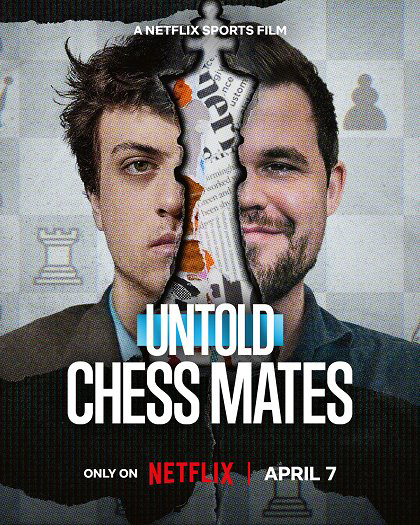
The scandal took a turn when Chess.com analysed the Saint Louis game along with other face-to-face games by Niemann and found no conclusive evidence that he had cheated. Niemann then sued Carlsen, Chess.com and other parties involved for hundreds of millions of dollars; in the end, the conflict ended in an out-of-court settlement.
Untold: Chess Mates reconstructs the whole case with the participation of Carlsen himself, although the Norwegian never actually apologises for the accusations that publicly called his rival’s reputation into question.