The return home of Odysseus
As well as becoming the cinematic phenomenon of the year, Nolan’s ‘The Odyssey’ has rekindled the passion for a classic that recounts the most epic journey in literature.
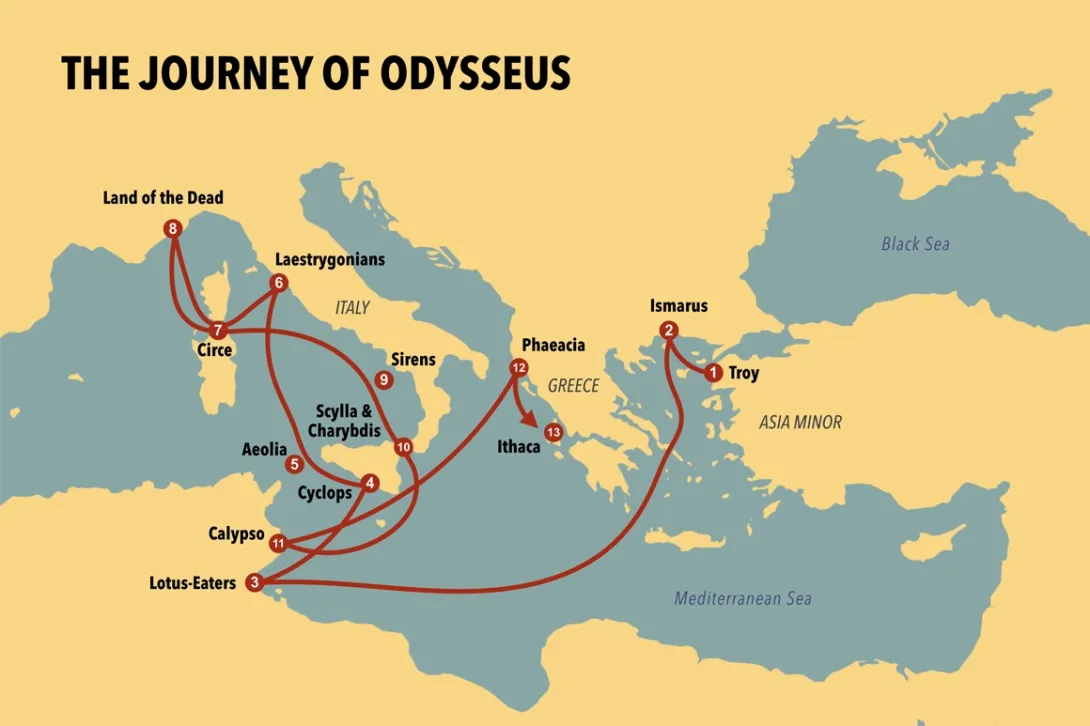
Mythology and reality, history and fantasy are interwoven in Homer’s account of the Greeks’ return home after the Trojan War. Archaeologists and cartographers have dreamed, for centuries, of plotting the mythical route of the Odyssey on a map; one of those that has gained most followers in recent years is the one proposed by Peter T. Struck, of the University of Pennsylvania, which we follow in this article.
From Troya to lotus-eaters country
In 1870, Heinrich Schliemann made one of the most important archaeological discoveries in history: Homer’s mighty Troy was real. Its ruins are in the Turkish locality of Hisarlık . It is from there that Odysseus, after ten years of a war to whose end he himself contributed decisively with his wooden horse ruse, sets off to return to Ithaca.
He does so with a fleet of twelve ships that puts in at Thrace, in the Balkans. In this locality, which Homer names Ismarus, the crew sack the city and kidnap its women; the locals’ revenge leaves dozens of Greeks dead.
At Cape Malea, in the south-east of the Peloponnese , strong winds make the sailors lose their course, and they are forced to endure ten days of terrible storms in nearby Cythera. The Tunisian island of Djerba, according to Struck, would be the place inhabited by the lotus-eaters, who fed on a flower that erased the memory. After eating it, the crew decide that they do not want to return home, but Odysseus forces them back on board.
The wrath of the god of the sea
It is in Sicily, near Mount Etna , where Odysseus seals his fate: to save his men from the Cyclops Polyphemus, he drives a stake into his single eye, leaving him blind. This unleashes the wrath of the giant’s father, none other than the god Poseidon, who grants his son’s prayer: that Odysseus should not return to his homeland or that, if he does, it should be after losing all his companions. Without leaving Sicily would be Homer’s island of Aeolia , where the crew open the bag of winds and again lose their course.
In the land of the Laestrygonians, which Struck places in North Africa, a veritable slaughter takes place: these cannibal giants destroy the fleet and devour most of the crew. Of twelve ships, only the hero’s manages to escape. That single vessel continues its journey towards one of the most iconic settings of The Odyssey, Aeaea . Unlike Bérard, who placed it in the south of Italy, Struck situates it in the Balearic Islands.
From the Circe's spell to Zeu's punishment
Here, the sorceress Circe turns the Greeks into pigs, but, thanks to a potion given to him by the god Hermes, Odysseus withstands the goddess’s magic and forces her to free his men. After reconciling, they enjoy her hospitality for a year; before letting them leave, Circe tells Odysseus that he must descend to the underworld to consult the seer Tiresias.
Whereas traditionally this was placed in Naples, Struck locates Hades near the Ebro delta. Here, the seer reveals to him the trials to which Poseidon will subject him and warns him not to touch the cattle of the god Helios.
In Sardinian waters, the hero withstands the dangerous magical song of the Sirens, who intend to drag him to the bottom of the sea, tied to the ship’s mast and with wax plugs in his ears. In the Strait of Messina and , the crew must sail between Scylla – a monster with six menacing heads that devoured sailors – and Charybdis – which created a giant whirlpool – to reach Thrinacia. On this island the crew, ignoring Circe, steal the cattle of Helios; Zeus punishes them by killing them all, leaving the hero alone.
The Odysseus final return to Ithaca
In Ogygia, which Struck places on the Valencian coast, Odysseus lives a seven-year romance with the nymph Calypso, who (unsuccessfully) promises him immortality if he stays by her side, but homesickness proves stronger and the hero sets off once more.
After a brutal storm sent by Poseidon, Odysseus reaches the shores of the island of the Phaeacians, Corsica, exhausted, where he lies on the shore until Princess Nausicaa finds him and helps him to reach Ithaca. On his return home, and after disguising himself as a beggar, he finishes off Penelope’s suitors and brings to an end all his sufferings and one of the greatest epics in literature.