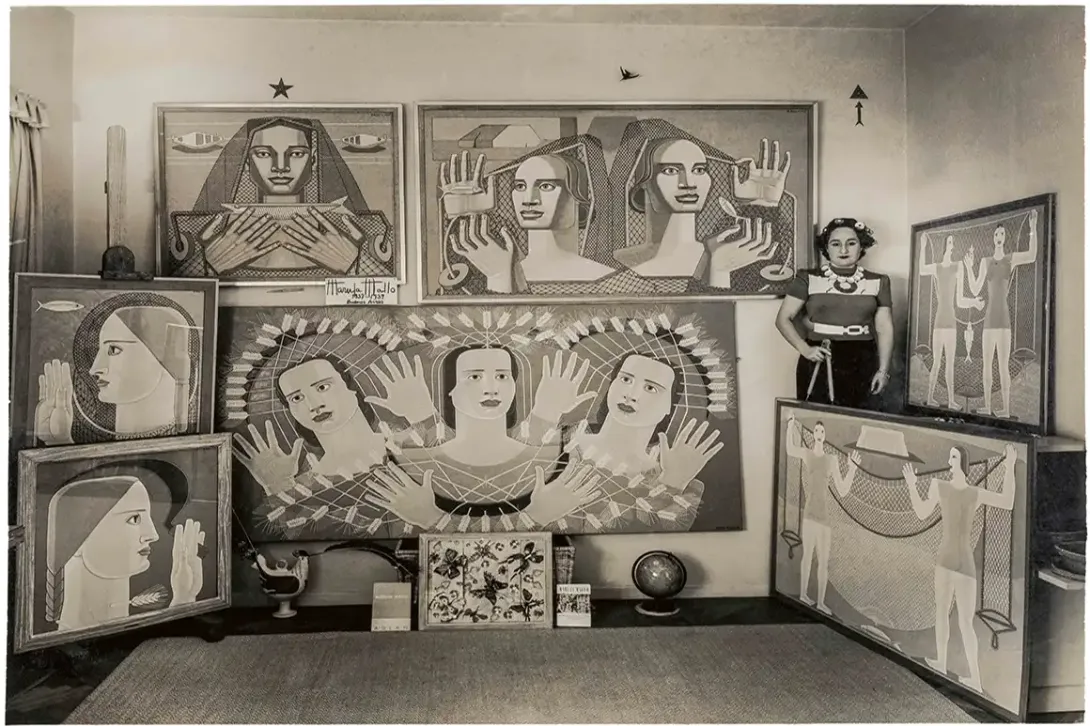
Maruja Mallo: The posthumous rebirth of a key figure of spanish surrealism
The Reina Sofia Museum recovers one of the most significant artists of the Spanish 20th century in order to pay back a historical debt.
Maruja Mallo decided to live without asking for permission and she marked a before and after in Spanish painting in the 20th century. Although her name has been unfairly relegated to footnotes or appendixes, her importance is comparable to her contemporaries Frida Kahlo or Georgia O’Keeffe. Born in 1902 in Viveiro (Galicia) and brought up in a large family where equality was encouraged, a rarity at that time, from an early age she learned that creativity could be a way of breathing. As a teenager she moved to Avilés and in her twenties she went to Madrid, where she discovered that art was not only a refuge, but rather a road she had to follow.
She entered the Royal Academy of Fine Art of San Fernando, where she was one of the first women to pass the entrance exams. There, she submerged herself in the latest ideas, sinking into a sparkling environment, becoming a regular at soirees alongside personalities such as Dalí, Lorca or Buñuel. Her presence in the Generation of the 27, was also not limited to a being an extra for the male personalities. She worked as an illustrator on literary publications such as La Gaceta Literaria, Almanaque Literario or Revista de Occidente and in this way, she began to gain popularity as an artist.
Alongside other renowned artists such as Concha Méndez or Margarita Manso, she would end up founding the group known as ‘Las Sinsombrero’ (The Hatless ones). And when she came up against a world that was not always ready for an artist like her, she decided to stand up for herself.
From daily routine to modernity
In her first works, Mallo submerged herself in the streets and the people, in pictures in which she liked to recreate festivals and fairs, portraying workers and common people. She praised the hands, the emblem of work, of health and of peace. With bright colours and figures crowded together, the first era portrays a marked social conscience that she would never leave behind.
In 1932 however, she travelled to Paris and surrealism dazzled her. She met André Breton, Picasso, Miró and works such as Espantapajaros (Scarecrow) were born in this phase, where the dreamlike and symbolic came together to create their own universe. Her style became more experimental, deeper: geometric, myths, nature reinvented.
Exile: American light and reinvention
The bitter, painful wound of the Civil War forced her to leave Spain, ending up in Buenos Aires, where she spent over two decades. If exile was painful, her creativity transformed it into a seed. In 1939 she concluded her most famous work, Canto de la Espiga (Wheat ears) and she published the book Lo popular en la plástica español a través de mi obra (What is popular in Spanish art because of my work).
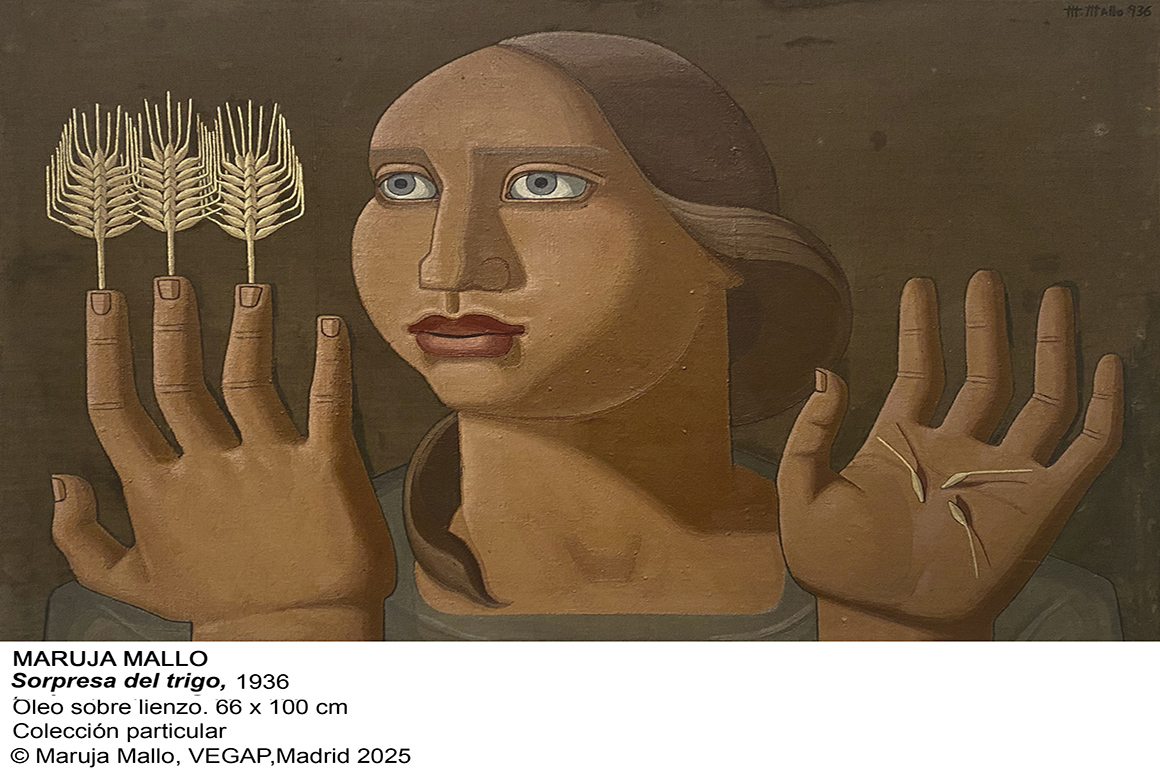
Even so, in Latin America she discovered new landscapes, new cultures and a lush natural world. This was particularly the case of the beaches in Chile, where the luxuriant nature of the beaches at Punta del Este and Punta Ballena amazed her. All of this inspired her to create her living nature paintings: shells, flowers, masks, organics shapes that talked to magical and scientific elements.
During this time, Mallo travelled and exhibited her works in Brazil, Argentina, Chile and New York, where she met and became friends with Andy Warhol. In 1949 she exhibited at the Carroll Carstairs Gallery, after winning the Painting Prize at the 2nd New York Exhibition the previous year with her work: ‘Cabeza de Mujer Negra’ (Black woman’s head).
The complete artist: avant-garde, method and freedom
Between October 2025 and March 2026, the Reina Sofia Museum will host the exhibition Maruja Mallo: Mask and Rhythm, the largest retrospective exhibition ever dedicated to the artist. The show brings together around two hundred pieces (paintings, drawings, sketches, photographs, personal documents) and it proposes a complete journey through her career, from her Madrilenian street fairs to her surrealist architectures and her final fascination for cosmic ideas.
The exhibition, organised in line with the criteria that Mallo herself used to structure her work, allows her creative universe to be discovered with an unprecedented depth: her geometric method, her interest in nature, her philosophical thinking and her visionary way of understanding modernity. It is, in short, an unrepeatable opportunity to once again find a figure who is essential in our art. A woman who lived as she painted: with freedom, with accuracy and with an untamable passion for the world that surrounded her.