How does IA affect the environment?
Global organisations are warning that the environmental impact of AI is putting increasing pressure on the planet’s resources.
Four years ago, one of the greatest technological advances of the 21st century was launched onto the digital market, completely transforming the way we access information, work and interact in the digital world.
By now, it is clear that we are referring to ChatGPT, the virtual assistant which, in a short space of time, has gone from generating basic responses to analysing complex information and producing increasingly realistic audiovisual content. Its arrival marked a turning point in the global expansion of artificial intelligence, to the extent that it has become integrated into various sectors and our everyday lives.
However, this rapid roll-out has also increased the pressure on natural resources. Its swift expansion and the lack of data on its ecological consequences have sparked an international debate on the environmental impact of AI, leading governments and global organisations to warn of the risks it poses and to promote regulatory frameworks to limit its ecological footprint.
The environmental cost of using ChatGPT
Every time we speak to a virtual assistant, whether to ask a question, draft a document or generate an image, there is an invisible energy cost. Each interaction consumes approximately 0.34 watt-hours.
The reason AI consumes so much energy is mainly due to three factors:
- The size of the new models. The more complex and advanced the systems are, the more resources and energy they require to process information and generate responses.
- The large volume of training data. The models need to process a massive amount of content to learn patterns and generate accurate responses. This process demands significant processing and storage capacity.
- The technological infrastructure. Training and operating these systems requires thousands of GPUs working simultaneously in data centres, which consume large amounts of electricity and emit tonnes of CO₂.
It is true that data centres are becoming increasingly efficient, but the rapid evolution of artificial intelligence is driving energy demand to grow faster than advances in efficiency.
Smart systems increase water stress
To date, the international debate has focused on measuring the carbon footprint produced by large AI models, whilst other, less visible environmental effects have been pushed into the background. This is the warning issued by the authors of the report The Environmental Cost of AI Energy Use by the United Nations, who also highlight the water-related impact associated with these systems.
In addition to server cooling, AI’s water footprint is also linked to the generation of the electricity that powers data centres. According to the report, the impact on water resources depends largely on where that energy is generated and the sources used to produce it.

Addressing the environmental impact of AI
In response to concerns about the widening digital divide, inequalities and the environmental impact of AI, in 2021 UNESCO member states adopted a global agreement to promote its ethical and responsible development and use.
However, some international organisations and authorities, such as the United Nations Environment Programme (UNEP), consider that current measures remain insufficient to address its environmental effects. They therefore advocate the development of national strategies that incorporate environmental and sustainability criteria.
In this context, UNEP proposes five key actions to manage the environmental consequences of AI on a global scale:
- Establish systems to collect reliable data on the environmental impact of AI.
- Increase the transparency of technology companies regarding the environmental costs associated with their tools and services.
- Improve the efficiency of AI infrastructure to reduce resource consumption.
- Make technology companies’ data centres more environmentally friendly, for example, through the use of renewable energy.
- Incorporate sustainability as a central pillar of public policies relating to AI.
A possible future where AI contributes to the planet?
Amid the public debate on the negative effects and environmental impact of AI, a question is emerging that could redefine this conversation: can this technology become an ally of sustainability?
For some experts, the answer is yes. They argue that artificial intelligence’s ability to analyse and process large volumes of data can help tackle some of the challenges associated with the climate crisis.
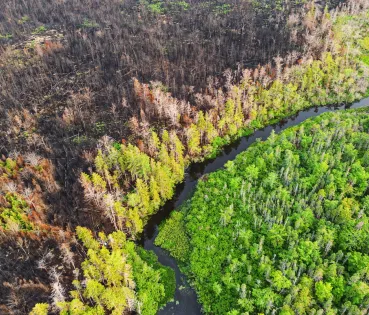
In fact, intelligent systems have already been implemented in environmental protection and monitoring projects, such as those developed in the Brazilian Amazon. During its first year of operation, the tool helped to identify 99 per cent of illegal deforestation and detect 15,000 km² of high-risk forest areas, 71 per cent of which were successfully preserved.
In line with this, here are other ways in which AI is contributing to the health of the planet, according to the World Economic Forum:
Whilst the negative effects and environmental impact of AI largely outweigh the opportunities it offers, the latest advances are pointing towards a future in which the perception of this technology as a climate ally could be redefined.