
What is the origin of Valentine’s Day?
Saint Valentine has uncertain origins, in which pagan rituals, a third-century martyr turned saint, and the modern consumerism are intertwined.
Valentine’s Day appears to have been strategically placed in the calendar to encourage spending after the Christmas holidays. 14 February, also known as Lovers’ Day, has become internationally popular as a celebration of love, friendship and romantic relationships.
However, beyond the commercial postcard image, the origin of Valentine’s Day becomes blurred. There is no single version or exact chronology explaining the beginnings of this celebration. Some of the best-known theories link it to ancient pagan rituals, violent accounts and religious persecutions, elements that have little to do with the romantic meaning attributed to it today.
The possible origin of Valentine’s Day lies in Rome
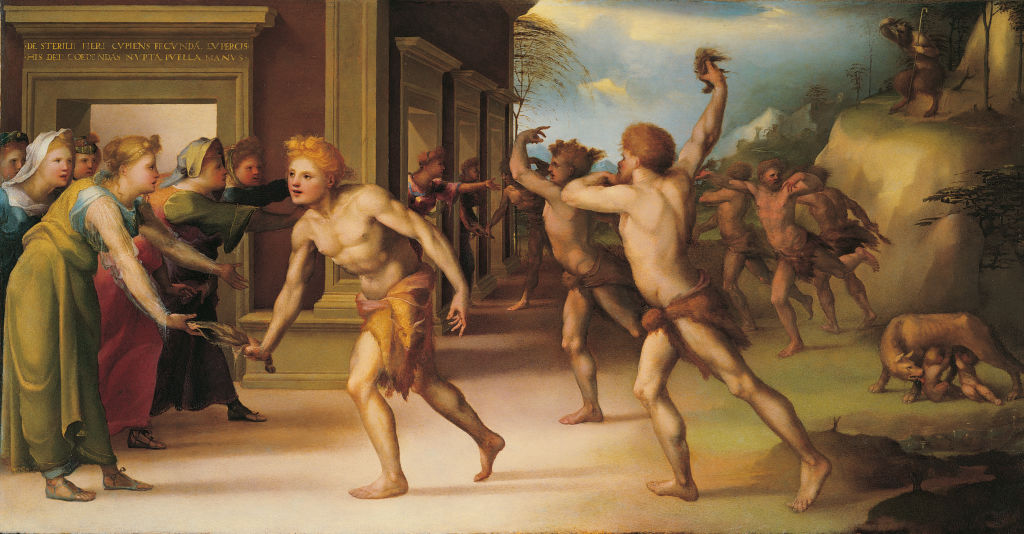
One theory about the origin of Valentine’s Day places its beginnings in classical Rome. From 13 to 15 February, the Romans celebrated the Lupercalia — also known as Lupercalia — a festival linked to fertility and purification rites. Far removed from romantic love, these celebrations are considered among the most violent and savage of the Roman Empire.
Lupercalia derives from the Latin lupus (wolf), and is believed to have been associated with the god Faun, as well as with an ancient deity who protected wolves and with Luperca, the legendary she-wolf who saved Romulus and Remus.
Every 15 February the acolytes gathered in a sacred cave and, following tradition, the Luperci priests sacrificed a goat and a dog. They would then go down to strike women with the animals’ skins to promote fertility. Afterwards, the skins were spread over farmland to bless the soil.
Who was Saint Valentine?
The most popular legend about the origin of Valentine’s Day dates back to the third century, a period of systematic persecution of Christians by the Romans. At that time, Emperor Claudius II Gothicus enacted a law that forbade young soldiers to marry, believing they made better fighters if they had no emotional ties.
Defying this law, a Christian priest named Valentine began to marry young lovers in secret under the Catholic rite, which contributed to the spread of Christianity and gradually turned him into a respected figure in the city.
After being discovered by the emperor, the priest was imprisoned in a dungeon. While behind bars, an officer challenged him to restore sight to his daughter Julia, who had been born blind. The young man accepted the challenge and, in the name of Jesus, healed her, leading the grateful family to convert to Christianity. Despite the miracle, Valentine remained imprisoned and on 14 February 269 he was beheaded and stoned.
Legend has it that Valentine fell in love with Julia and, before his death, sent her a note signed “From your Valentine”, the traditional expression used nowadays to sign letters on Valentine’s Day.
The origin of Valentine’s Day: legend intertwined with consumerism
There are other theories about the origin of Valentine’s Day. One is attributed to the English poet Geoffrey Chaucer in the late fourteenth century. In his work The Parliament of Foules, the author mentions that 14 February was the day when birds chose their mates, the first known reference linking this date to romantic love. However, in 1969, the Catholic Church removed the saint from the liturgical calendar due to the lack of historical evidence and proof of the priest’s existence.
Years later, the celebration re-emerged driven by consumerism, and beyond the mysterious origin of Valentine’s Day, this date has become established as a celebration of love.